How venture capital actually works
Almost every company that changed how we live started the same way. A small team, an idea most people thought was crazy, and no proof that it would work.
A bank will not lend to that. There is nothing to lend against. Venture capital is the money that exists for exactly those people. The founders take the risk. The investor only funds it.
But most founders I meet misunderstand what that money is for.
A founder I know told me a fund had passed on them. They were growing, close to profitable, and their customers loved the product. “What did they miss?”
I looked at it for a while. They hadn’t missed anything. It was a good business. It would probably become a company doing tens of millions a year and pay its founders well for a long time. That was exactly why the fund said no.
So venture capital backs ideas that look crazy and passes on businesses that look good. That looks like a mistake. It isn’t. Once you see why, most of what VCs do starts to make sense.
Start with where the money comes from.
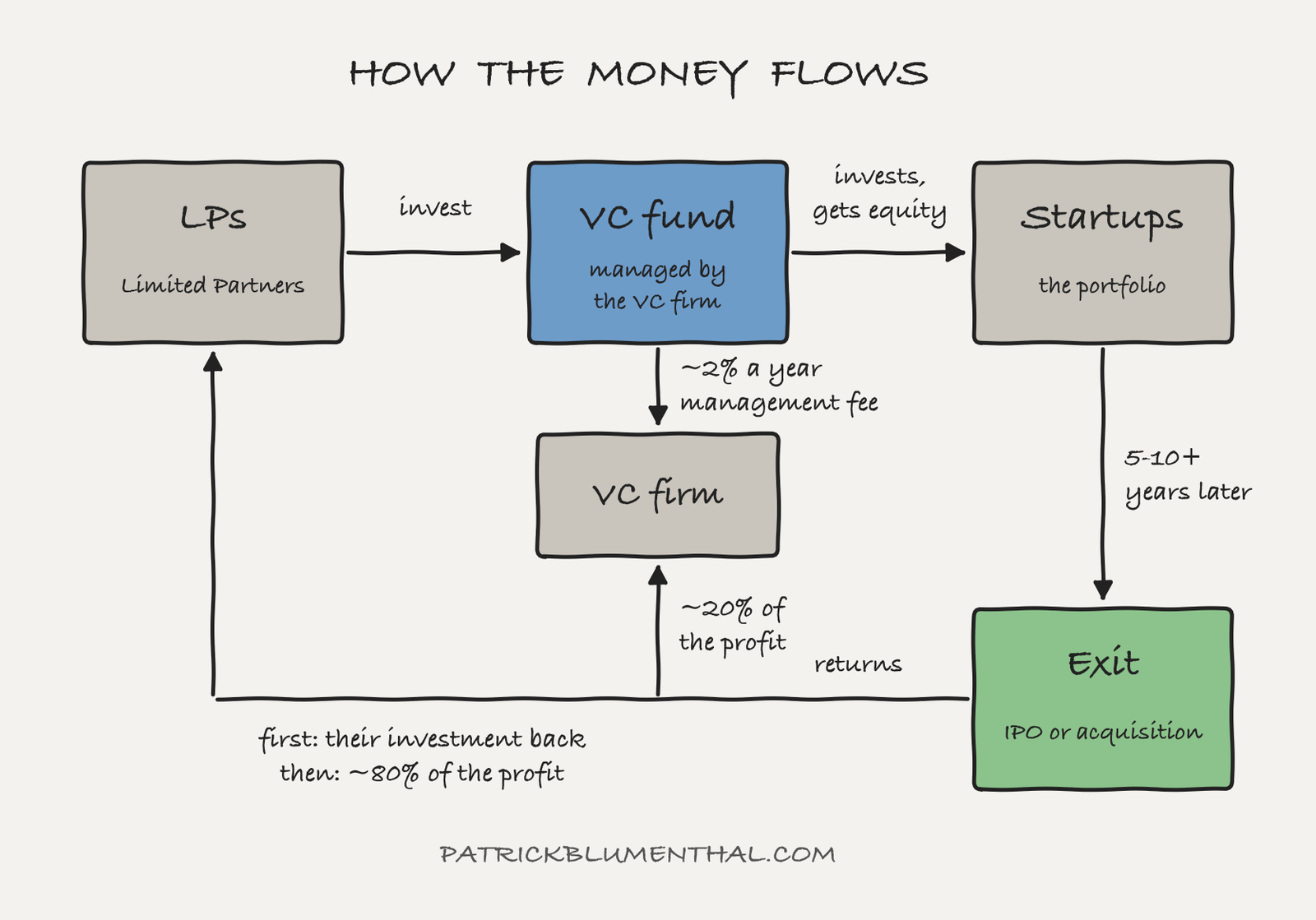
A venture fund is mostly not the VC’s own money. The VC firm, called the General Partner, runs the fund and usually puts in only 1-2% itself. The rest comes from investors called Limited Partners (LPs): pension funds, university endowments, foundations, family offices, wealthy individuals, sovereign wealth funds and funds of funds. They promise the money upfront and pay it in over time, as the fund needs it. The VC’s job is to invest it in startups, in exchange for shares.
A fund lives about ten years, often longer. It makes new investments in the first two to five years, then helps those companies grow and waits for an exit, when a buyer or the stock market pays cash for the fund’s shares. Only then does the money come back.
The VC is paid in two ways, usually called “2 and 20”. About 2% of the fund each year pays salaries and costs. About 20% of the profit goes to the VC, usually only after the LPs have their money back.
Companies raise this money in stages. Pre-seed and seed is an idea and a team. Series A and B is a company that is growing. Later rounds are for companies with real revenue.
Now look at it from the LP’s side. For most of them, venture is a small slice of a much bigger portfolio. It is there partly to spread their risk, but above all for one thing: returns the stock market can’t give. And they pay for that. They lock their money away for ten years, when they could have put it in an index fund and taken it out any day they wanted. So a venture fund has to beat the stock market by a lot, or there is no reason for it to exist. Many don’t.
So how do the ones that win, win?
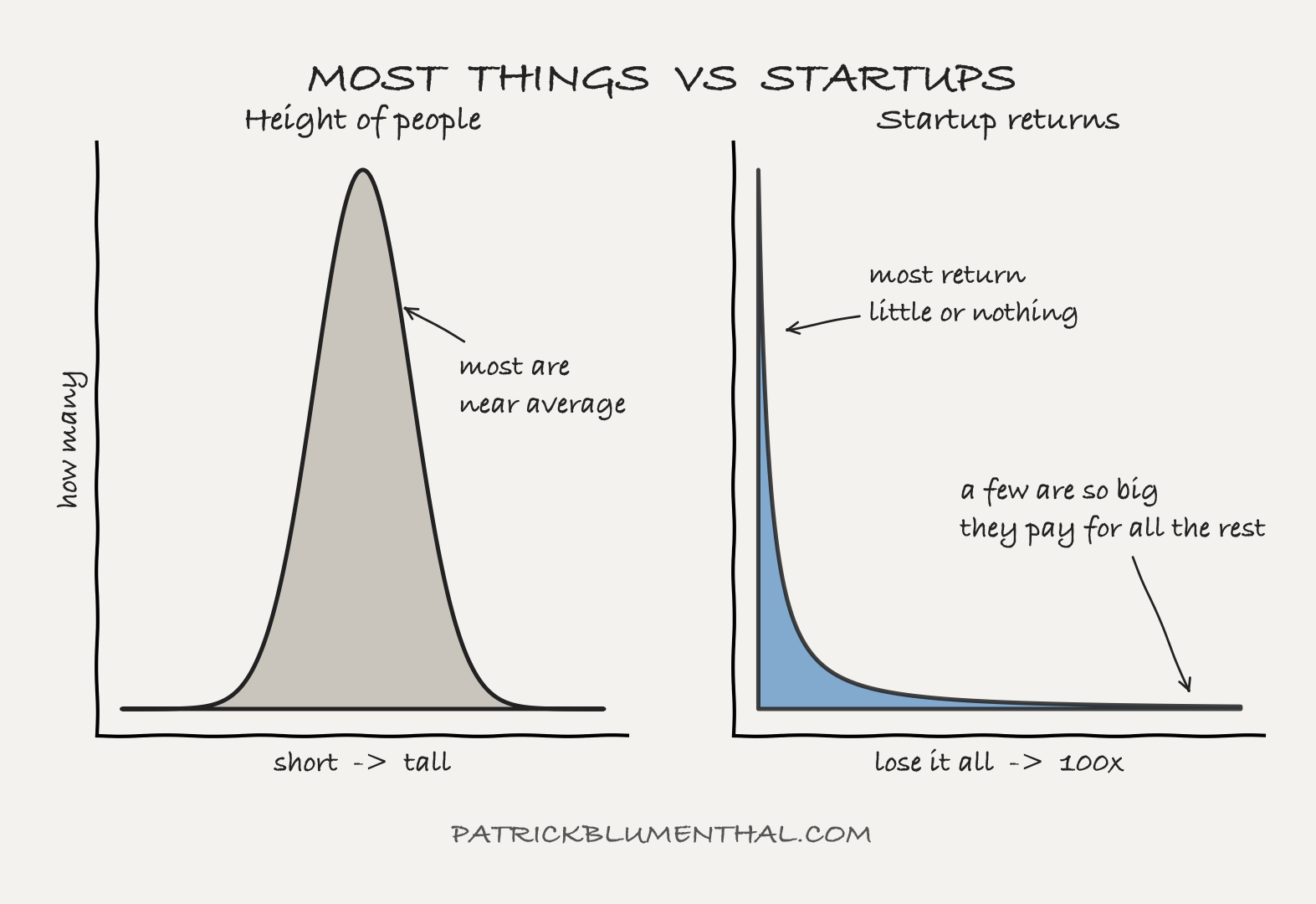
Through one fact about startups. VCs call it the power law. The best investment in a fund is often worth more than all the others combined.
Most things you know follow a bell curve. Take people’s height: most are close to average, and nobody is ten times taller than anyone else. Startup returns don’t work like that. Most return little or nothing, and a few are so big they pay for all the rest.
Across thousands of venture investments, about two in three lose money. Only about one in twenty-five returns ten times or more, and those few make most of the money.
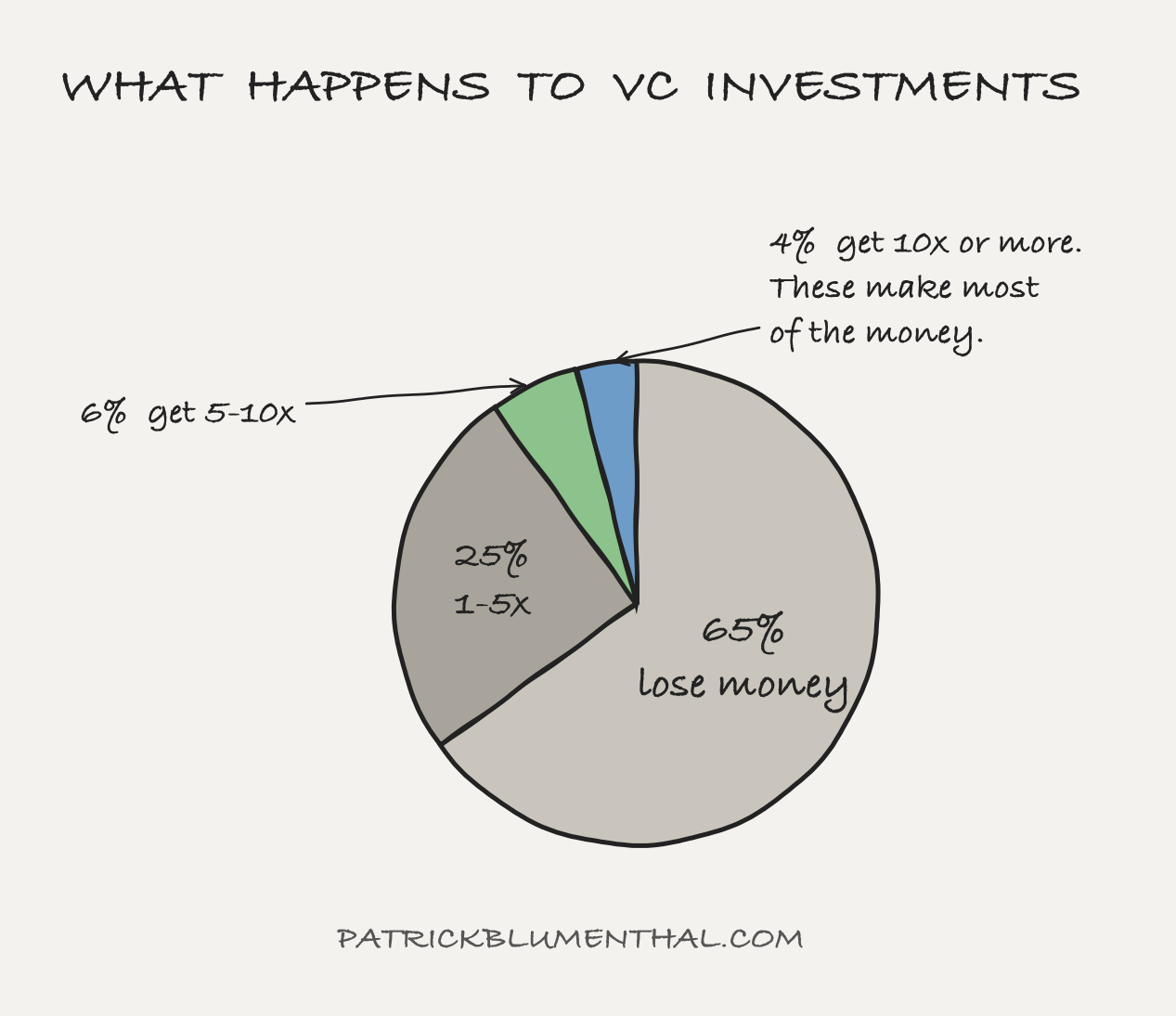
This is not bad picking. It is the shape of the game. Even the best investors lose money on most of their companies. They win because one of them becomes enormous.
It has been like this from the start. ARD, often called the first modern venture capital firm, invested $70,000 in a company called Digital Equipment in 1957. By 1971 that stake was worth about $355 million. Over 25 years, ARD returned 14.7% a year. Take out that one company and it falls to 7.4%. The first modern venture firm was already one company carrying everything.
Once you see that, the question a VC asks changes.
A normal investor asks: will this work? A VC asks: if this works, how big can it get?
Because one winner has to pay for all the losers, missing a winner is much worse than backing a few companies that fail. A company that fails costs you what you put in. Missing the big one can cost you the whole fund.
I learned this slowly. When I started in venture capital, I looked for reasons to say no. The market is too small. The team is light. Someone bigger will copy it. There is always something wrong, so I always found it. It took me a while to see that my questions could only ever produce a no. So I changed the question. Not “what could go wrong here?” but “how big is this if it works?”
The math shows why that is the right question. Take a $100 million fund.
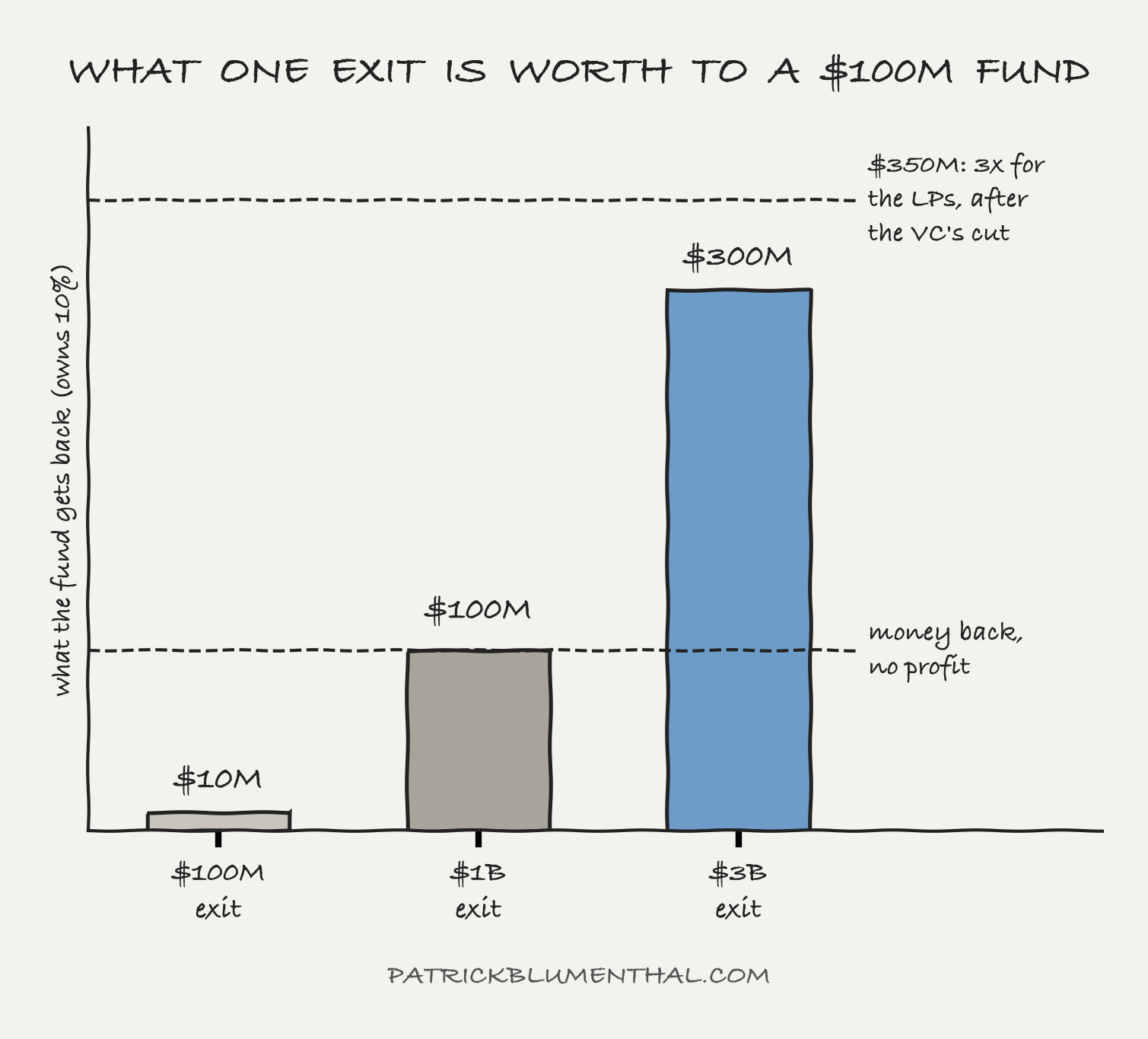
A good early-stage fund aims to give its LPs about three times their money back, after fees and the VC’s share. That is $300 million: their $100 million back, plus $200 million of profit. But the VC takes about 20% of the profit, so the LPs’ $200 million is only 80% of it. The total profit has to be $250 million: $200 million for the LPs and $50 million for the VC. So the companies in the fund have to return about $350 million.
Most of them will return little or nothing. So one or two companies have to deliver most of it.
A seed fund usually buys 10 to 20% of a company. Every later round shrinks that stake, so by the time the company is sold, the fund often owns around 10%, and only if it kept investing along the way. So a company sold for $1 billion gives the fund $100 million. That only gives the LPs their money back. To make the fund a real success, you need something closer to a $3 billion company, or a few worth more than $1 billion each.
And a $3 billion company usually needs hundreds of millions in revenue a year, built within about ten years.
A $1 billion exit doesn’t make a fund. It gives the money back.
This is why VCs keep asking about the same three things:
- How big is the market?
- How fast are you growing?
- Can the business grow without its costs growing just as fast?
It is not that nothing else matters. It is that without those three, the math doesn’t work.
That one question explains most of what founders find strange about VCs. Four things in particular.
First, why they pass on good businesses. The question is not “is this good?” but “could this be the one?” That is why the fund passed on the founder at the start. A great business can still be the wrong bet if it can never return a whole fund. “Not venture-backable” is not an insult. It means not big enough for venture, not bad.
Second, why the best deals look crazy. If everyone agrees an idea is good, the price already reflects that, and there is no big return left in it. The companies that ended up returning whole funds almost all looked wrong at first. Too early, too big, too strange. Most crazy ideas are just bad, and VCs know that. But a VC who only backs ideas that sound sensible will never own the one that matters. This is the part of the job I love. You get to take people seriously before everyone else does.
Third, why they say “keep me updated” instead of no. It is not a yes and it is not a no. It means the VC doesn’t have conviction yet. A no risks closing the door on the one company that could return the fund. A yes needs conviction they don’t have. So they wait for the founder to give them a reason. The honest translation is: nothing I saw today was enough. The useful response is not a monthly email hoping they change their mind. It is coming back when something real has changed: paying customers, a product that works, a hire nobody expected. Your job is to create the conviction, not to wait for it.
Fourth, and most important, why at the earliest stage they bet on the founder more than the plan. There are usually no numbers yet, and the plan will probably change. Many companies pivot, sometimes more than once, and the product they end up with is not the one they pitched. So the plan is not really what is being judged. At that stage I am asking two things. Can these people build something huge, whatever the product turns out to be? And what does this look like in ten years if it works? The vision matters because it shows how big the founder is aiming. A founder who can’t describe the ten-year version is usually pitching a good business, not a venture one. And the ones who go the distance rarely talk about their fundraise. They talk about the problem.
The founder is the whole bet. The money is replaceable. The founder is not. The best VCs know they work for the founder, not the other way round.
So what does a founder do with all this?
Venture capital is a tool for one kind of company. It is not a badge every good company should collect. Before you raise, ask yourself the question the VC is asking: if everything goes right, can this become big enough to return a whole fund?
If the answer is no, that is not a failure. You may be building a better business than most venture-backed companies, just one that should be funded another way: from revenue, from a bank, or from angels who are happy with a good return.
If the answer is yes, this money exists for you. There are people whose whole job is to bet on founders trying something most people think can’t be done. Pitch them the size of what happens if it works, not the safety of the plan.
Which brings me back to the founder whose good business got passed on. They weren’t wrong about their company, and neither was the fund. They were answering different questions.
Crazy and good were never opposites. They are two answers to the same question: how big can this get? And the founders with the crazy idea are the ones that question was made for.